From the workshop
Who I am and why I do it.
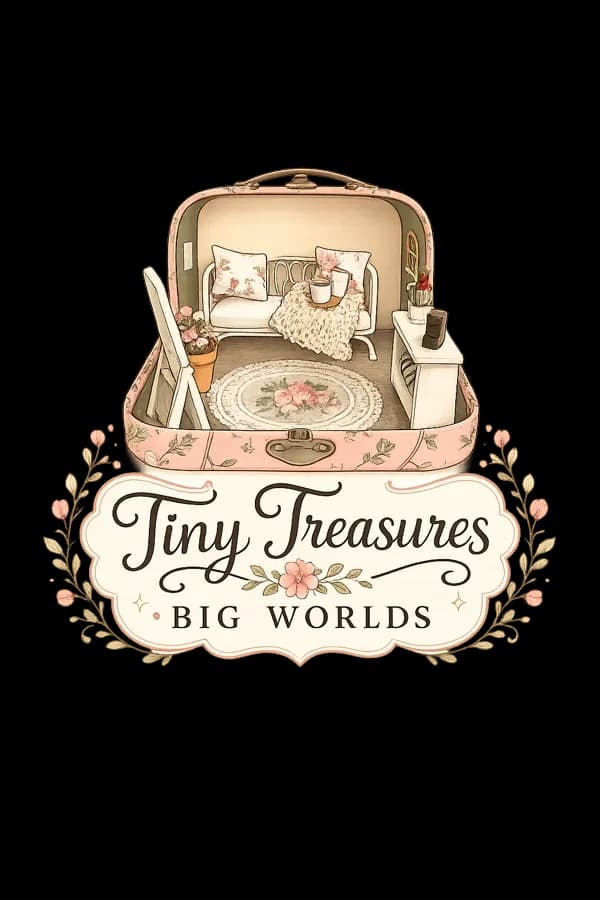
There is something special about opening a suitcase and discovering a world inside.
Not a world of grand adventures or dramatic stories, but something quieter. A room with a lamp glowing in the corner. A chair waiting beside a table. A book left open. A coat hung by the door. Tiny details that suggest life without explaining everything.
That feeling sits at the heart of Tiny Treasures Big Worlds.
People often ask where the idea comes from. The answer is surprisingly simple. It begins with a love of making things by hand.
As a child, some of the happiest hours were spent creating. There was comfort in making something from nothing. A few materials, a little imagination and a blank space could become almost anything. The process itself was absorbing. The outside world became quieter. Time slowed down. The focus shifted entirely to what was being made.
Many people experience this through painting, sewing, writing or gardening. For some, it comes through music. For others, it comes through cooking. For me, it came through creating miniature spaces.
Years later, that feeling never disappeared.
Life becomes busy. Responsibilities increase. The world moves quickly. Yet there remains something deeply satisfying about creating a tiny space with your own hands and watching it slowly come to life.
Tiny Treasures Big Worlds grew from that simple idea.
It was never planned as a business from the beginning. Like many creative projects, it started much more modestly. The first suitcase rooms were created because they were practical. Working within a suitcase was affordable and manageable. It provided a contained space in which ideas could develop without needing endless materials or a dedicated workshop.
The suitcase solved a practical problem.
Over time, however, it became much more than that.
A suitcase creates boundaries. It contains a world. It invites curiosity. The moment the lid opens, the ordinary room around it fades slightly into the background and attention shifts somewhere else.
That feeling became impossible to ignore.
The suitcase was no longer simply a container. It had become part of the experience.
Every suitcase room represents a small act of escape.
Not escape in the sense of running away from reality, but escape in the way a favourite book can transport us somewhere else for an hour. Escape in the way a beautiful film can create a temporary pause from everyday concerns. Escape in the way imagination allows us to step beyond what is directly in front of us.
Imagination is often associated with childhood, yet it remains one of the most valuable parts of being human. As adults, we sometimes forget how important it is.
We become focused on practicalities. We learn to prioritise productivity. We fill calendars and to-do lists. We spend more time looking at screens than looking around us. Imagination quietly waits in the background.
Miniature worlds invite it back.
A tiny room asks questions without demanding answers. Who lives here? What has just happened? What will happen next? The room itself never explains. Instead, it leaves space for the viewer to decide.
That openness is important.
Many of the scenes created for Tiny Treasures Big Worlds are inspired by vintage interiors and bygone eras. Yet they are not intended to recreate history with perfect accuracy. They are not museums in miniature.
What draws me towards vintage spaces is something less tangible.
It is atmosphere.
There is a particular feeling that exists in older interiors. Worn furniture. Faded wallpaper. Soft lighting. Objects that have clearly been used and loved over many years. These details carry a sense of history, even when the story itself remains unknown.
They suggest lives rather than explain them.
Perhaps that is why vintage settings feel so compelling. They create a sense of distance from modern life. Many of us feel drawn towards periods we never actually experienced. We imagine slower days, quieter evenings and simpler routines. Whether those assumptions are entirely accurate is almost irrelevant. What matters is the feeling they create.
Vintage spaces allow us to step briefly into another world.
The worlds inside these suitcases are often influenced by that same sense of longing. Not nostalgia for a specific memory, but nostalgia for a feeling. A room can feel familiar even when it belongs to a time we never lived through.
That emotional contradiction is fascinating. It creates a mood that is difficult to define but instantly recognisable.
A gentle melancholy. Not sadness. Not happiness. Something that exists somewhere between the two.
Many of the rooms created for Tiny Treasures Big Worlds live in that space.
A lamp glowing late in the evening. A chair left slightly askew. A half-finished cup of tea. A stack of books beside a bed. Tiny details that suggest presence through absence.
These are often the final additions to a scene. They are also some of the most important.
When creating miniature rooms, it is easy to focus on furniture, colours and construction. Those elements matter, of course. Yet a room rarely feels alive until signs of life appear.
The smallest details frequently carry the greatest emotional weight.
A blanket draped carelessly across a chair. A notebook left open on a desk. A pair of spectacles resting beside a book. These objects transform a collection of miniatures into something more meaningful. They suggest that somebody has just stepped out of view.
The viewer becomes part of the story. Or perhaps part of the mood.
Because the truth is that these rooms are rarely built around specific characters. There are no detailed biographies hidden behind them. No carefully planned narratives.
Instead, each scene begins with a feeling. A mood. The mood develops gradually as materials are gathered and arranged. The room slowly reveals itself.
Sometimes an old wallpaper pattern becomes the starting point. Sometimes it is a piece of miniature furniture. Sometimes it is simply a colour palette or texture that feels right.
There is rarely a rigid plan. The process is intuitive.
That unpredictability remains one of the most enjoyable parts of creating. A scene may begin as one thing and become something entirely different. New ideas emerge along the way. Unexpected combinations appear. Small imperfections often become favourite details.
The room evolves naturally rather than following strict instructions.
Perhaps that is another reason miniature worlds remain so appealing. They offer freedom.
Within the boundaries of a suitcase, anything is possible. An ordinary object can become extraordinary. A forgotten corner can become the centre of attention. A handful of materials can become an entire world.
There is something quietly magical about that transformation.
The name Tiny Treasures Big Worlds reflects this idea perfectly. The rooms themselves are small. The emotions, memories and possibilities they contain are much larger.
Every completed piece represents hours of careful attention. Every commission begins with trust. When someone commissions a miniature room, they are inviting another person to help create a world that exists only in imagination until it becomes real.
That process never loses its significance.
Each commission is different. Each room develops its own atmosphere. Yet the intention remains the same.
To create a space that encourages people to pause. To look closer. To notice details. To imagine.
The world often encourages us to move faster. Miniatures encourage the opposite. They reward patience. The more time spent looking, the more details reveal themselves.
A tiny framed picture. A carefully placed book. A subtle texture on a wall. A shadow in a corner. These details are not always noticed immediately. That is part of their charm. They wait quietly until somebody discovers them.
In many ways, creating miniature rooms is an exercise in observation. It encourages appreciation for the small things that are often overlooked.
A worn armchair. A favourite mug. The pattern of light across a room. The objects that make a space feel lived in. The details that turn a house into a home.
These things matter. Not because they are valuable. Because they are meaningful.
Significance is not always measured by size.
Perhaps that is why miniature worlds continue to resonate with people. They remind us that significance is not always measured by size.
A tiny object can hold enormous emotional weight. A tiny room can contain an entire atmosphere. A tiny suitcase can become a doorway into another place.
Tiny Treasures Big Worlds exists because of that belief. A belief in imagination. A belief in craftsmanship. A belief in the quiet power of small details.
Most of all, it exists because creating these worlds continues to bring the same sense of focus and wonder that first appeared many years ago through making things by hand.
The materials may have changed. The rooms may have become more detailed. The collection may have grown. Yet the feeling remains remarkably similar.
A blank space. A handful of materials. An idea waiting to emerge. And somewhere within it all, another tiny world waiting to be discovered.