How to add realistic detail to a miniature room: the small things
Ten details that turn a miniature room from a furniture showroom into somewhere that looks lived in, from a half-drunk cup to the art of leaving something slightly out of place.
July 2026 · 8 min read · By Margaret
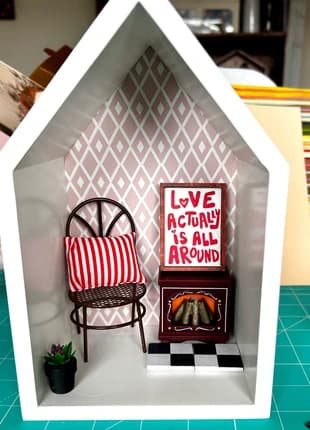
Here is the difference between the two kinds of miniature room. In the first, everything is neat, square to the wall, and perfect. It looks like a catalogue. In the second, a cushion is dented, a book is face down, one cup has been drunk from and one has not, and the rug is very slightly askew. It looks like somebody got up a minute ago and will be back shortly. The second one is what everyone is actually trying to make.
The gap between them is not skill or money. It is a set of small decisions, most of which take seconds. These are the ten that do the most work.
Leave something unfinished
A half-drunk cup of tea, a partly eaten biscuit, a letter opened and set down. An unfinished action implies a person, and a person implies a life. This single trick does more than any amount of extra furniture. If you add nothing else from this list, add this.
Break the right angles
Real rooms are not square. Nudge the rug a few degrees off parallel. Pull one chair back from the table as though somebody stood up. Turn a book so it does not align with the shelf edge. Perfect alignment reads as a display; slight misalignment reads as life. Do this to about a third of the objects, not all of them, or it starts to look staged in a different way.
Add soft things that have been sat on
New fabric in miniature looks like fabric. Fabric with a dent in it looks like a cushion someone leaned against. Press a thumb into cushions, drape a blanket so it falls off the arm rather than folded in a neat square, rumple the bedding slightly. Gravity and use are what make textiles believable.
Vary the heights
A room where everything sits at table height is boring to look at. Put something on the floor, something at mid-height and something up high: a basket by the hearth, a lamp on the table, a picture on the wall. The eye travels up and down and the room feels three-dimensional rather than like a shelf of objects.
Use odd numbers and uneven groups
Three books, not four. Five jars, not six. Group things unevenly, with a cluster here and a gap there. Even, evenly-spaced arrangements are the visual signature of a shop display. Uneven clusters are how objects actually end up on a real table.
Give the light somewhere to come from
Even without working electrics, you can imply a light source. A lamp with a warm-toned shade, a fire with orange behind it, a window with a pale wash of colour. Then place the brightest, most detailed objects nearest that source. A scene with an implied direction of light reads as photographed rather than assembled.
Add one thing that does not match
A real home is never a single coherent set. There is always one chair that came from somewhere else, one mug that does not go with the others. Deliberately include one piece that breaks the scheme, in a different wood or colour. It is the fastest way to stop a room looking bought as a kit.
Fill the edges, not just the middle
Beginners tend to arrange everything centrally and leave the corners bare. Real rooms accumulate at the edges: something leaning against a wall, a pair of shoes by the door, a basket tucked beside the fireplace. Putting a few objects in the corners makes the room feel occupied rather than staged.
Mind the underside of the details
At miniature scale you often see things from angles you would never see in life, including from below and behind. Colour in white cut edges on printed card, paint the backs of anything that will be seen from the side, and make sure nothing is balanced on a blob of visible glue. These are the details that quietly break the illusion.
Then take one thing out
The final and hardest step. When the room is finished, remove one object. Almost always it improves. Detail works by suggestion, not by inventory, and a scene with a little breathing space around each thing lets the eye notice them individually. Cluttered is not the same as lived in.
If you want a shortcut to the small things themselves, the accessory bundles are exactly that: the teacups, towels, books, jars and tools that give a room its lived-in layer, sold in small handfuls rather than one at a time.
Adding realistic detail: common questions
How do I make a miniature room look lived in?
Imply a person rather than adding more furniture. Leave an unfinished action such as a half-drunk cup or an open book, nudge a few objects off their right angles, and dent the cushions. Those three things do most of the work.
How much detail is too much in a miniature scene?
When objects start crowding each other so the eye cannot settle on any one of them, you have gone past lived-in into cluttered. A good habit is to finish the room and then remove one object, which almost always improves it.
What small accessories make the biggest difference?
Anything that implies use: cups, plates with food, open books, folded towels, baskets and tools. Objects associated with an activity suggest somebody was recently there, which is what makes a room feel occupied.
Why does my miniature room look like a showroom?
Usually because everything is perfectly aligned, evenly spaced and matching. Break some right angles, group things in odd numbers, fill the corners as well as the centre, and add one piece that deliberately does not match the scheme.
Read next
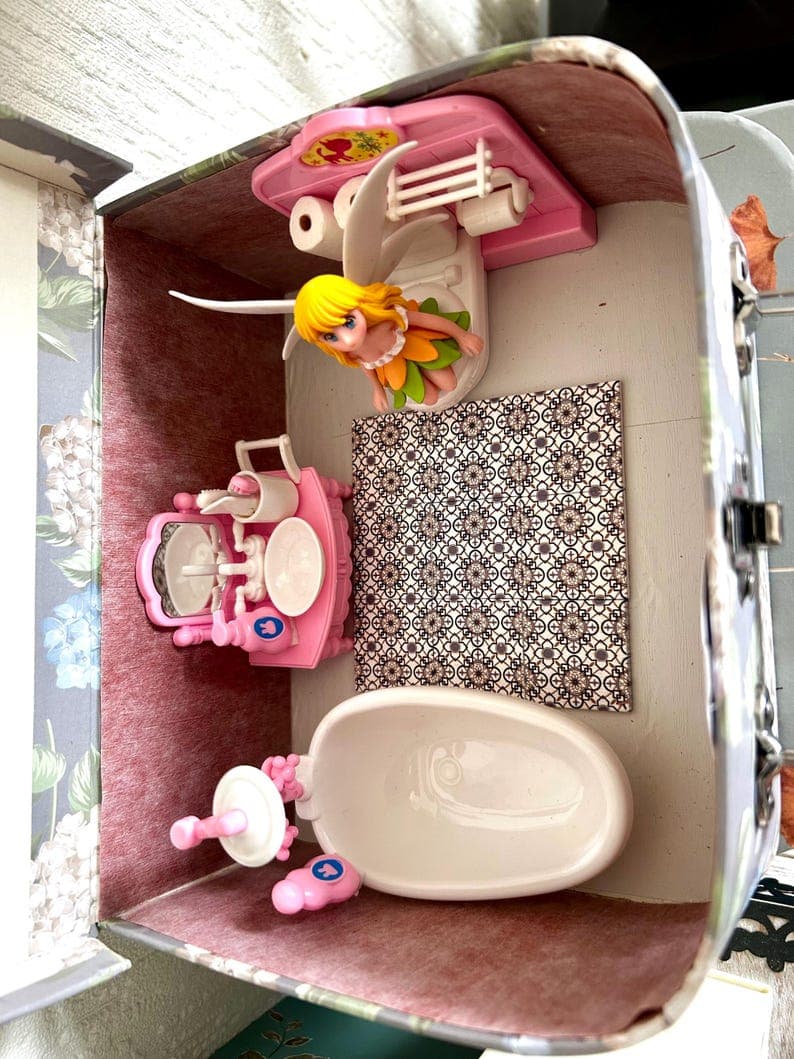
Ageing and weathering miniatures: how to make new things look old
Dry-brushing, washes, edge wear and the tea-staining trick. Five gentle techniques for taking the shine off new miniatures so they look like they have been in the family for years.
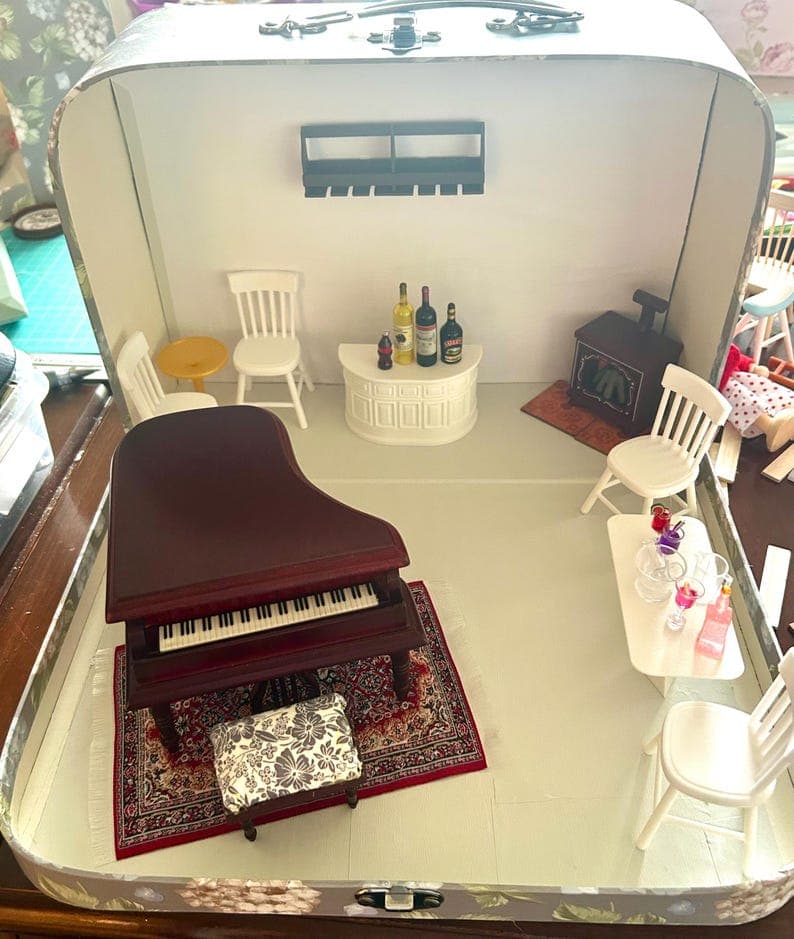
What miniature furniture is made from, and how to tell quality from tat
Wood, resin, metal, printed card and 3D print: what each material means for how a miniature looks, lasts and photographs, plus six checks for spotting a well-made piece before you buy.
How to display miniature rooms: shelves, walls and suitcase dioramas
Six ways to show off a miniature room so it actually gets lived with, from a floating shelf to a case that closes and travels, plus how to keep dust and sunlight from spoiling it.
Written by Margaret at the workshop. Browse current pieces →